
About ADAMTS13
ADAMTS13
A disintegrin and metalloprotease with a thrombospondin type 1 motif, member 13 (ADAMTS13) acts within the circulation to cleave high molecular weight multimers of von Willebrand Factor (vWF) into smaller forms and thereby controls vWF-mediated platelet thrombus formation. ADAMTS13 is encoded by a 45kb gene located on chromosome 9q34.2, and is clinically important as deficiency causes Thrombotic Thrombocytopenic Purpura (TTP), a rare condition which, if untreated, has a mortality of greater than 90%.
ADAMTS13 Structure
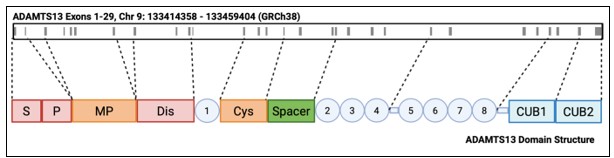
ADAMTS13 consists of 1427 amino acids, with a molecular weight of roughly 154 kDa. It contains a domain structure consisting of a signal peptide, propeptide, metalloprotease, disintegrin, cysteine-rich, spacer, eight thrombospondin type-1 repeats, and two CUB (complement C1r/C1s, Uegf, Bmp1) domains.
The metalloprotease activity acts to cleave von Willebrand factor between Tyrosine 842 and Methionine 843 within the vWF A2 domain and relies on calcium and zinc ions as cofactors for enzymatic activity.
ADAMTS13 Activity
ADAMTS13 acts to cleave vWF when vWF is unfolded in response to shear forces within the circulation. No physiological inhibitors to ADAMTS13 have so far been identified, suggesting that regulation of ADAMTS13 activity is primarily due to the availability of the scissile bond within the A2 domain of vWF.
The catalytic site contains important residues including His224, His228, His234 and Glu225, together with a zinc ion cofactor. Calcium binding is also required at an exosite for catalytic activity.
TTP – ADAMTS13 Deficiency
Thrombotic Thrombocytopenic Purpura (TTP) occurs due to a deficiency of ADAMTS13 and is a medical emergency. If untreated, mortality exceeds 90%.
Two forms of TTP are recognised:
- Immune TTP (iTTP) – an autoimmune condition in which inhibitory autoantibodies lead to a deficiency of ADAMTS13.
- Congenital TTP (cTTP) – caused by inherited biallelic variants in ADAMTS13.
TTP is a rare condition with an estimated incidence of approximately 6 cases per million, and fewer than 10% of these cases are congenital.
Clinical Features
Clinical features of TTP include microangiopathic haemolytic anaemia (MAHA) and thrombocytopenia. Patients may also present with neurological symptoms such as headaches, confusion or seizures, as well as renal impairment or cardiac involvement.
Treatment
Acute TTP is a medical emergency. Initial treatment for immune TTP typically involves plasma exchange to remove inhibitory antibodies and replace deficient ADAMTS13, immunosuppression using corticosteroids and Rituximab, and treatment with caplacizumab which targets the vWF A2 domain and prevents platelet-rich microthrombi formation.
With prompt initiation of treatment, mortality can be reduced to below 10%.
Treatment of congenital TTP involves replacement of ADAMTS13 activity. Traditionally this has been achieved with plasma infusion, however recombinant ADAMTS13 therapy now provides a safe and effective treatment option.
TTP – Support
This website is maintained for research purposes only and does not provide medical advice. If you or someone you know has been diagnosed with TTP, TTP Network provides support and information for patients and families.
References
1. Scully M, Rayment R, Clark A, Westwood JP, Cranfield T, Gooding R, Bagot CN, Taylor A, Sankar V, Gale D, Dutt T, McIntyre J, Lester W; BSH Committee. A British Society for Haematology Guideline: Diagnosis and management of thrombotic thrombocytopenic purpura and thrombotic microangiopathies. Br J Haematol. 2023 Nov;203(4):546-563. doi: 10.1111/bjh.19026. Epub 2023 Aug 16.
2. Petri, A., Kim, H.J., Xu, Y. et al. Crystal structure and substrate-induced activation of ADAMTS13. Nat Commun 10, 3781 (2019). https://doi.org/10.1038/s41467-019-11474-5